|
ISHA
(2:10), KATHA (20:16), AITAREYA (4:35), BRIHADARANYAKA
(19:45), MUNDAKA (9:55),
SVETASVATARA (13:20), KENA (6:30), TAITTIRIYA
(7:45), CHANDOGYA (9:43)
This
recording contains
materials deleted from the CD due to time constraints:
Mundaka Upanishad and Kena Upanishad
Original
Liner notes
Back
Cover:
The Upanishads,
from which these selections have been recorded, form the
concluding portion of the Vedas. The Vedas
are the oldest and most important scriptures of India.
There are four Vedas — the Rik, the Sama,
The Yajur, and the Atharva. Each Veda
comprises two parts: a work portion and a knowledge
portion. The work portion includes prayers, hymns, rules
of conduct, and instruction for the performance of
sacrificial rituals and duties. The knowledge portion
consists of the Upanishads. It is also known as Vedanta.
The
Vedas are, to the Hindu, as nearly as any
human document can be, the expression of divine truth.
And he believes that a sincere aspirant, by practicing
spiritual disciplines under qualified guidance, can,
through his own experience, verify the truths of Vedas.
The scriptures themselves uphold the position that their
validity lies in their capacity for verification. The
real study, declares the Upanishads, is not of
the Upanishads but of that “by which we realize
the changeless.”
The
word upanishad means sitting nearby,” bringing
to mind the picture of a disciple learning from his
teacher. It also means “secret teaching,” the
teaching which may be imparted only to those who are fit
to receive it. A third meaning is given by the great
philosopher Shankara, who defined upanishad as
“the knowledge of Brahman, the knowledge that destroys
the bonds of ignorance and leads to the supreme goal of
freedom.”
The
most authoritative opinion assigns the earliest of the Upanishads
to a period between 3000 B.C. and 800 B.C. One hundred
and eight Upanishads have been preserved, these
ranging in length from a few hundred to many thousands
of words. Some of them are in prose, some in verse, and
some in a combination of the two. Ten Upanishads
are regarded as being of major importance and they have
become the principal source for the study of the Hindu
religion.
The
ancient sages of the Upanishads reported the
mystical experiences revealed to them in exalted states
of spiritual realization. Their visions and insights
were later developed into philosophical systems. But
whatever philosophical views may be derived from a
reading of these great religious documents, the
fundamental fact remains that they stand as a witness of
an unchangeable reality behind the universe of change,
and that this reality is identical with the essential
reality of man.
Swami
Prabhavananda, a senior monk of the Ramakrishna Order of
India, is a noted author on religion and philosophy and
a translator of India’s spiritual classics. His point
of view is different from that of a Western scholar, in
that he speaks always as one born to the religious
tradition of India. The aim of the
Prabhavananda-Manchester translation has been to convey
in clear and simple English the sense and spirit of the
original.
Christopher
Isherwood is the well-known writer who collaborated with
Swami Prabhavananda in translating the Bhagavad
Gita, The Yoga Aphorisms of Patanjali, and Shankara’s
Crest-Jewel of Discrimination.
Special thanks to
Christopher Isherwood for reading the selections, to Jan
Steward for designing the album, to Charles Mitchell and
Jon Monday for supervising the production, and to Dorris
Carlson without whose encouragement and help this
recording would not have been made.
Original 1976 Interior Notes
ISHA
The Isha
Upanishad derives its name from the opening word of the
text. It is first in the traditional order of the Upanishads,
partly because of the spiritual significance of its contents and
partly because it is the only Upanishad found in a Samhita
(a portion of the Vedas concerned with hymns). It forms the last
chapter of the White Yajur Veda Samhita. This Upanishad
lays down two paths for spiritual aspirants: the path of
knowledge and the path of work. The end of both is to know the
Self within and Brahman without (imminent and
transcendant reality) and to realize their identity.
In
the heart of all things, of whatever there is in the universe,
dwells
the Lord.
He
alone is the reality.
Wherefore,
renouncing vain appearances, rejoice in him.
Covet
no man’s wealth.
Well
may he be content to live a hundred years
who
acts without attachment —
who
works his work with earnestness, but without desire,
not
yearning for its fruits —
he,
and he alone.
Worlds
there are without suns, covered up with darkness.
To
these, after death, go the ignorant,
slayers
of the Self.
The
Self is one.
Unmoving,
it moves swifter than thought.
The
senses do not overtake it, for always it goes before.
Remaining
still, it outstrips all that run.
Without
the Self, there is no life.
To
the ignorant the Self appears to move — yet it moves not.
From
the ignorant it is far distant — yet it is near.
It
is within all, and it is without all.
He
who sees all beings in the Self, and the Self in all beings,
hates
none.
To
the illumined soul, the Self is all.
For
him who sees everywhere oneness,
how
can there be delusion or grief?
KATHA
This Upanishad
is one of the most poetic and popular of all the Upanishads
and belongs to the Black Yajur Veda. By relating the
teachings of the King of death to the boy Nachiketa, it
illustrates how the qualified spiritual seeker, who purifies his
heart through meditation, obtains the secret of immortality.
Know
that the self is the rider and the body the chariot;
that
the intellect is the charioteer and the mind the reins.
The
senses, say the wise, are the horses;
the
roads they travel are the maze of desire.
The
wise call the self the enjoyer
when
he is united with the body, the sense, and the mind.
When
a man lacks discrimination and his mind is uncontrolled,
his
senses are unmanageable,
like
the restive horses of a charioteer.
But
when a man has discrimination and his mind is controlled,
his
senses,
like
the well-broken horses of a charioteer,
lightly
obey the rein.
He
who lacks discrimination,
whose
mind is unsteady and whose heart is impure,
never
reaches the goal,
but
is born again and again.
But
he who has discrimination, whose mind is steady and whose heart
is oure,
reaches
the goal,
and
having reached it
is
born no more.
AITEREYA
The Aitereya
Upanishad belongs to a part of the Rig Veda which,
according to modern scholars, originated probably more than
three thousand years ago. This Upanishad takes its name
from the sage Mahidasa Aitereya, whose mother’s name was Itara
— hence Aitereya. According to tradition, Mahidasa’s father
had other sons whom he loved more than Mahidasa. In a
sacrificial assembly Mahidasa was denied the privilege of
sitting on his father’s lap. Itara, grieved by the plight of
her son, prayed to the Goddess Earth, who, in response to her
prayer, appeared in divine form.
She placed Mahidasa on a celestial seat and imparted
wisdom to him. Thus enlightened, Mahidasa Aitereya later
revealed that part of the Veda known by his name.
Essentially, this Upanishad teaches that the reality
behind this universe is Brahman — Existence-Knowledge-Bliss
absolute.
The opening
chant of the Aitereya Upanishad follows:
May
my speech be one with my mind,
and
may my mind be one with my speech.
O
thou self-luminous Brahman,
remove
the veil of ignorance from before me,
that
I may behold thy light.
Do
thou reveal to me the spirit of the scriptures.
May
the truth of the scriptures be ever present to me.
May
I seek day and night to realize
what
I learn from the sages.
May
I speak the truth of Brahman.
May
I speak the truth.
May
it protect me.
May
it protect my teacher.
OM…Peace
— peace — peace.
BRIHADARANYAKA
Brihat
means great. This Upanishad is great not only in size but
in content and importance as well. A part of the White Yajur
Veda, it consists of six chapters called Aranyaka, as
it was taught in the forest (aranya). This Upanishad
exemplifies the lofty philosophy of Vedanta by teaching
the realization of the Self as the goal of life. The method
presented is hearing the truth, reflecting upon it, and
meditating upon it.
From an
ethical standpoint, a teaching of the Brihadaranyaka
Upanishad is dramatically conveyed in the selection that
follows: the exhortation that all should practice self-control,
charity, and compassion in order to eradicate the tendencies of
lust, greed, and anger.
Gods,
men and asuras (demons) —
all
three descendants of Prajapati (the Creator) —
lived
with him for a time as students.
Then
the gods said, “Teach us, sir!”
In
reply Prajapati uttered one syllable “Da.”
Then
he said: “Have you understood?”
They
answered, “Yes, we have understood. You said to us
‘Damayata
— Be self-controlled.’”
“Yes,”
agreed Prajapati, “you have understood.”
Then
the men said, “Teach us, sir!”
In
reply Prajapati uttered one syllable “Da.”
Then
he said: “Have you understood?”
They
answered, “Yes, we have understood. You said to us
‘Datta
— Be charitable.’”
“Yes,”
agreed Prajapati, “you have understood.”
Then
the asuras said, “Teach us, sir!”
In
reply Prajapati uttered one syllable “Da.”
Then
he said: “Have you understood?”
They
answered, “Yes, we have understood. You said to us
‘Dayadhwam
— Be compassionate.’”
“Yes,”
agreed Prajapati, “you have understood.”
The
storm cloud thunders:
“Da!
Da! Da!” —
“Be
self-controlled! Be charitable! Be compassionate!”
MUNDAKA
The
Mundaka Upanishad forms a part of the Atharva
Veda. This Upanishad takes its name from the
Sanskrit mund, “to shave,” and mundaka,
shaven head, referring to a monk. It is said that the
supreme wisdom so lucidly taught in this Upanishad
removes the veil of ignorance obscuring the Self (the Atman)
just as a razor shaves the hair of the head. Also, this Upanishad
emphasizes the need of renunciation for the attainment
of liberation from worldly bondage.
Affix to the
Upanishad,
the bow incomparable, the sharp arrow of devotional
worship;
then,
with mind absorbed and heart melted in love,
draw
the arrow and hit the mark —
the
imperishable Brahman.
OM
is the bow, the arrow is the individual being,
and
Brahman is the target.
With
a tranquil heart, take aim.
Lose
thyself in him, even as the arrow is lost in the target.
In
him are woven heaven, earth, and sky,
Together
with the mind and all the senses.
Know
him, the Self alone.
Give
up vain talk.
He
is the bridge of immortality.
Within
the lotus of the heart he dwells,
where, like the spokes of the wheel in its hub, the nerves meet.
Meditate
on him as OM.
Easily
mayest thou cross the sea of darkness.
This
self,
who
understands all, who knows all,
and
whose glory is manifest in the universe,
lives
within the lotus of the heart,
the
bright throne of Brahman.
By
the pure in heart is he known.
The
Self exists in man, within the lotus of the heart,
and
is the master of his life and of his body.
With
mind illumined by the power of meditation,
the
wise know him, the blissful, the immortal.
The
knot of the heart, which is ignorance, is loosed,
all
doubts are dissolved, all evil effects of deeds are
destroyed,
when
he who is both personal and impersonal is realized.
In
the effulgent lotus of the heart dwells Brahman,
who
is passionless and indivisible.
He
is pure, he is the light of lights.
Him
the knowers of the Self attain.
Like
two bird of golden plumage, inseparable companions,
the
individual self and the immortal Self are perched
on
the branches of the selfsame tree.
The
former tastes of the sweet and bitter fruits of the
tree;
the
latter, tasting of neither, calmly observes.
The
individual self,
deluded
by forgetfulness of his identity with the divine Self,
bewildered
by his ego,
grieves
and is sad.
But
when
he recognizes the worshipful Lord as his own true Self,
and
beholds his glory,
he
grieves no more.
When
the seer beholds the Effulgent One,
the Lord, the Supreme Being,
then,
transcending
both good and evil, and freed from impurities,
he
unites himself with him.
The
Lord is the one life shining forth from every creature.
Seeing
him present in all,
the
wise man is humble, puts not himself forward.
His
delight is in the Self, his joy is in the Self,
He
serves the Lord in all.
Such
as he, indeed, are the true knowers of Brahman.
SVETASVATARA
The
Svetasvatara Upanishad, which is part of the Black
Yajur Veda, receives its name from the sage who
taught it. Its importance is testified to by the fact
that it is one of the eleven Upanishads on which
the great philosopher Shankara wrote commentaries. Its
emphasis is not on the impersonal and changeless but on
the personal aspect of the ultimate reality. Containing
ideas akin to all three great philosophical standpoints
— dualism, qualified nondualism, and nondualism —
this Upanishad is an attempt to reconcile various
conflicting religious and philosophical views of its
times. The Svetasvatara Upanishad contains some
of the most poetic and sublime passages in the entire Upanishadic
literature.
Hear,
all ye children of immortal bliss,
also
ye gods who dwell in the high heavens:
Follow
only in the footsteps of the illumined ones,
and
by continuous meditation
merge
both mind and intellect in the eternal Brahman.
The
glorious Lord will be revealed to you.
Control
the vital force.
Set
fire to the Self within by the practice of meditation.
Be
drunk with the wine of divine love.
Thus
shall you reach perfection.
Said
the great seer Svetasvatara:
I
have known, beyond all darkness,
that
great person of golden effulgence.
Only
by knowing him does one conquer death.
There
is no other way of escaping the wheel
of
birth, death, and rebirth.
There
is nothing superior to him, nothing different from him,
nothing
subtler or greater than he.
Alone
he stands, changeless, self-luminous;
he,
the Great One, fills this universe.
Though
he fills the universe, he transcends it.
He
is untouched by its sorrow.
He
has no form.
Those
who know him become immortal.
Others
remain in the depths of misery.
The
Lord God, all-pervading and omnipresent,
dwells
in the heart of all beings.
Full
of grace, he ultimately gives liberation to all
creatures
by
turning their faces towards himself.
He
is the innermost Self.
He
is the great Lord.
He
it is that reveals the purity within the heart
by
means of which he, who is pure being, may be reached.
He
is the ruler.
He
is the great Light, shining forever.
KENA
The
Sanskrit word Kena means “by whom,” and like
the Isha, this Upanishad owes its name to its
first word. Found in the Sama Veda, the Kena
Upanishad is half verse and half prose. The first
part deals with the unqualified Brahman, the
absolute principle underlying the phenomenal world. The
second half contains a charming allegory (included in
this recording), which illustrates that the power behind
every activity of nature and of man is the power of Brahman.
The
peace chant of the Kena Upanishad follows:
May
quietness descend upon my limbs,
My
speech, my breath my eyes, me ears;
May
all my senses wax clear and strong.
May
Brahman show himself unto me.
Never
may I deny Brahman or Brahman me.
I
with him and he with me — may we abide always
together.
May
there be revealed to me,
Who
am devoted to Brahman,
The
holy truth of the Upanishads.
OM
. . . Peace — peace — peace.
TAITTIRYA
The
Taittiriya Upanishad belongs to the Black
Yajur Veda and is one of the most authoritative and
widely studied texts on Vedanta philosophy. It
comprises three chapters. The subject matter of the
first is concerned with rules of right conduct; the
second with the study of and meditation on Brahman;
and the third with the revelations of the sage Brighu.
The excerpt here is from the second chapter.
The
Self-Existent is the essence of all felicity.
Who
could live, who could breath,
if
that blissful Self dwelt not within the lotus of the
heart?
He
it is that gives joy.
When
a man finds existence and unity in the Self —
who
is the basis of life,
who
is beyond the senses,
who
is formless, inexpressible, beyond all predicates —
then
alone does he transcend fear.
So
long as there is the least idea of separation from him,
there
is fear.
To
the man who thinks himself learned,
yet
knows not himself as Brahman,
Brahman,
who drives away all fear, appears as fear itself.
Concerning
which truth it is written:
Through
fear of Brahman the wind blows and the sun shines;
through
fear of him
Indra,
the god of rain, Agni, the god of fire,
and
Yama, the god of death,
perform
their tasks.
He
who is the Self in man, and he who is the Self in the
sun,
are
one.
Verily,
he who knows this truth overcomes the world;
he
transcends the physical sheath,
he
transcends the vital sheath,
he
transcends the mental sheath,
he
transcends the sheath of the ego.
It
is written: He who knows the joy of Brahman,
which
words cannot express and the mind cannot reach,
is
free form fear.
He
is not distressed by the thought,
“Why
did I not do what is right? Why did I do what is
wrong?”
He
knows the joy of Brahman,
knowing
both good and evil,
transcends
both.
CHANDOGYA
The
Chandogya Upanishad is part of the Sama Veda.
Chandoga is the singer of the Saman (or Vedic
hymn). Sri Krishna gave special honor to the Sama
Veda in the Bhagavad-Gita, declaring: “Of
the Vedas, I am the Sama Veda.”
The
Chandogya Upanishad says, in essence, that Brahman
is all. From Brahman comes appearances,
sensations, desires, deeds. But all these are merely
name and form. To know Brahman one must
experience the identity between him and the Self, or Brahman
dwelling in the heart. Only by so doing can man escape
from sorrow and death.
Within
the city of Brahman, which is the body,
there
is the heart,
and
within the heart there is a little house.
This
house has the shape of a lotus,
and
within it dwells that which is to be sought after,
inquired
about, and realized.
What
then is that which, dwelling within this little house,
this
lotus of the heart,
is
to be sought after, inquired about, and realized?
As
large as the universe outside,
even
so large is the universe within the lotus of the heart.
Within
it are heaven and earth, the sun, the moon,
the
lightening, and all the stars.
What
is in the macrocosm is in this microcosm.
All
things that exist, all beings and all desires,
are
in the city of Brahman;
what
then becomes of them when old age approaches
and
the body dissolves in death?
Though
old age comes to the body,
the
lotus of the heart does not grow old.
At
death of the body, it does not die.
The
lotus of the heart, where Brahman exists in all his
glory —
that,
and not the body, is the true city of Brahman.
Brahman,
dwelling therein, is untouched by any deed,
ageless,
deathless, free from grief,
free
from hunger and from thirst.
His
desires are right desires,
and
his desires are fulfilled.
The
Selected Upanishads CD is an edited and re-mastered
re-issue of this 1976 LP. Issued with permission of
Vedanta Press. The book Upanishads: Breath of the
Eternal from which these readings are taken,
translated by Swami Prabhavananda and Frederick
Manchester, as well as other related works are available
from Vedanta
Press.
Original
Recording
©
1976
Vedanta Society of Southern California |


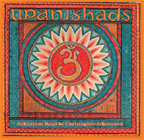 Selected
Upanishads Read by Christopher Isherwood
Selected
Upanishads Read by Christopher Isherwood